How AI search cites self-promotional content.


 Minuttia
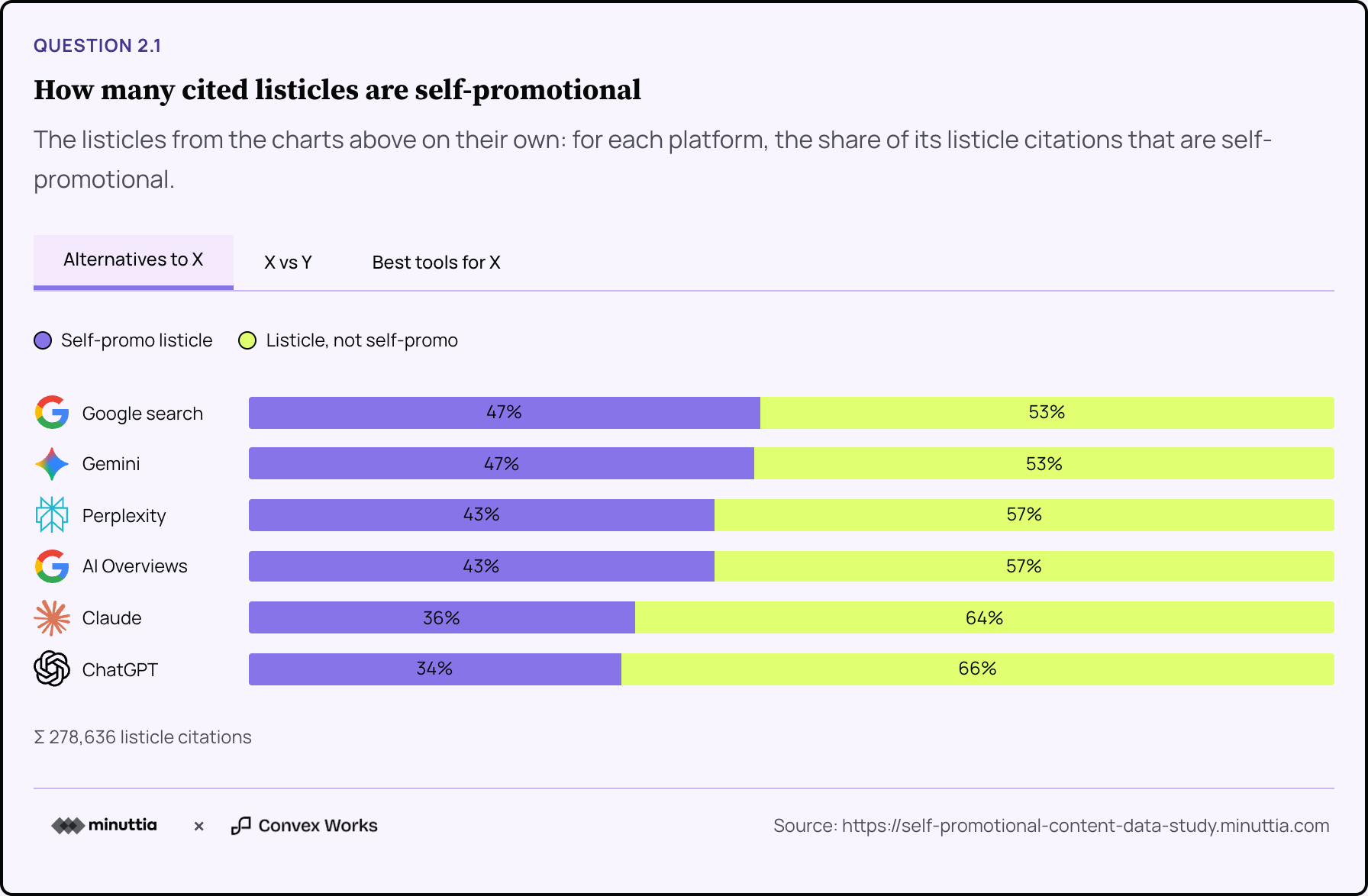
Our first study with Minuttia measured which software brands appeared in AI answers. For the second study, we asked how often those answers cite companies’ own articles recommending their products.
We found this a little absurd. You can write a list of the best tools in your market, place your own product first, and have an AI cite that article when someone asks what to buy.
Of course we understand why companies do it. We also want people to choose us.
We analysed responses to 18,084 software questions across Google Search, AI Overviews, ChatGPT, Gemini, Claude and Perplexity. We used three prompt templates:
- Category: “What are the best tools for {category}?”
- Alternatives: “What are the best alternatives to {brand} for {category}?”
- Comparison: “How do {brand} and {competitor} compare for {category}?”
The answers cited more than 311,000 different pages. We built data-mining pipelines to collect the source material and connect it to our software-brand dataset. We used DataForSEO for much of the collection and ran the jobs in parallel.
We matched publisher websites to the brands in our dataset. We removed repeated page elements while preserving product lists and comparison tables. We then designed the classification questions around the relationship between the publisher and the products it recommended.
We used TypeSafe to apply those questions to the pages we could read. We combined the outputs in DuckDB and wrote the analysis in Python. We kept the source data separate so we could test new comparisons without repeating the collection.
Study publisher